
Image compression
Image upload in the wrapper is always asynchronous. The API never runs Sharp
itself, so a CPU-bound compression can never block the event loop and starve
request handling. An upload returns 202 Accepted immediately; a separate worker
process does the actual compression and replaces the object in place; the client
polls a job endpoint for the result.
The flow at a glance
Section titled “The flow at a glance”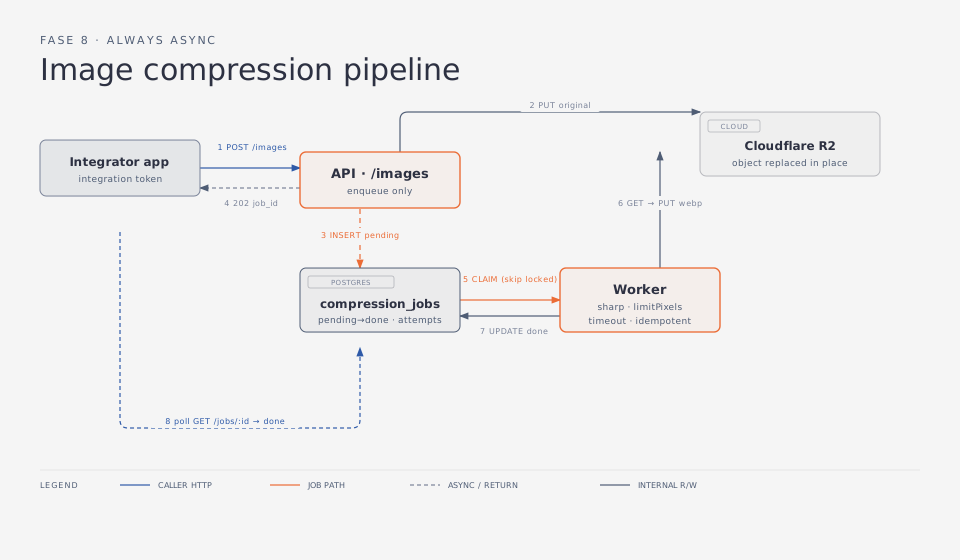
See it in the demo
Section titled “See it in the demo”The bundled demo app drives this exact pipeline. A 9.0 KB PNG uploaded with the
medium preset returns 202 immediately, the worker compresses it to a 966 B
WEBP (a 90% saving), and the page polls the job until it shows the result:
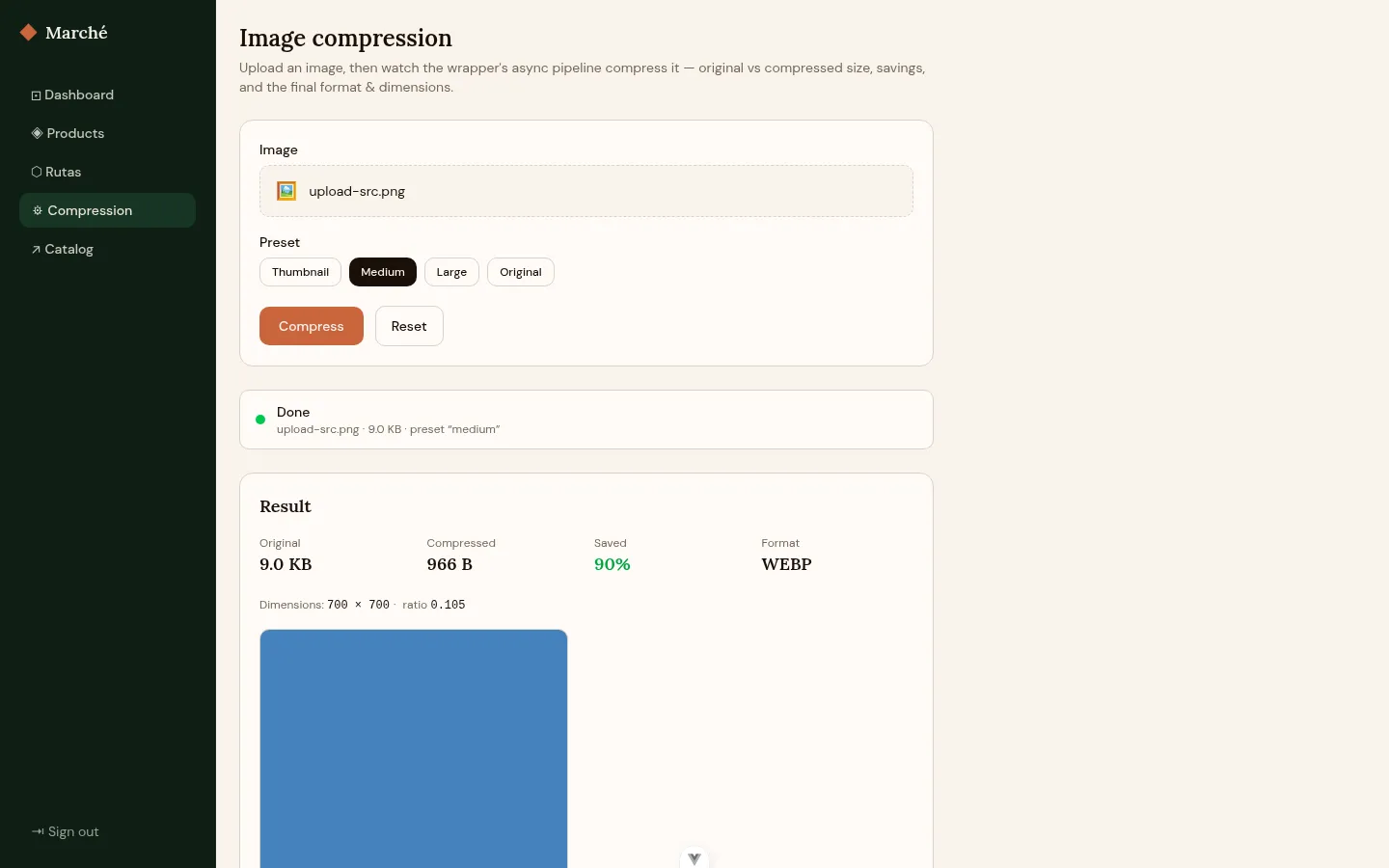
Step 1 — Upload
Section titled “Step 1 — Upload”curl -X POST "$BASE/project/users/MASTER_UUID/images" \ -H "Authorization: Bearer $TOKEN" \ -F image=@photo.png \ -F preset=medium \ -F format=webp \ -F quality=80# → 202 { "job_id": "…", "file_id": "…", "status": "pending" }The endpoint (apps/api/src/routes/images.ts) requires the files:write scope
and pins the subject. It:
- Validates the
imagemultipart field and the compression params. - Enforces the same plan constraints as a normal upload —
max_file_size,allowed_mimes,storage_limit— plus the per-space sub-limit if the caller is a space token. Quota is charged against the original bytes (conservative: the worker frees the delta once it shrinks the object, so the system never over-admits). - Uploads the original to R2 and, in a single transaction, inserts the
filesrow, incrementsstorage_used, and inserts apendingcompression_jobsrow. One transaction means a mid-sequence failure never leaves a committed file row with no job, or a phantom storage charge. - Wakes the worker (best-effort Redis push) and returns
202.
An external-id variant exists: POST /project/users/ext/:externalId/images.
Parameters
Section titled “Parameters”All optional; a bare upload with just image defaults to webp @ q80, no resize.
| Field | Values | Notes |
|---|---|---|
preset |
thumbnail | medium | large | original |
a named bundle of format/quality/dimensions |
format |
webp | jpeg | png | avif |
overrides the preset’s format |
quality |
1–100 |
overrides the preset’s quality |
width |
1–10000 |
max width (aspect preserved, never upscaled) |
height |
1–10000 |
max height (aspect preserved, never upscaled) |
visibility |
public | private |
default private |
folder, tags, classifier, metadata |
— | same semantics as a normal file |
Explicit parameters override the preset. The preset table
(apps/api/src/lib/image-compression.ts):
| Preset | Format | Quality | Width | Height |
|---|---|---|---|---|
thumbnail |
webp | 75 | 150 | 150 |
medium |
webp | 80 | 800 | — |
large |
webp | 85 | 1920 | — |
original |
webp | 90 | — | — |
Resizing uses fit: 'inside' with withoutEnlargement: a dimension is a maximum
bound, aspect ratio is preserved, and a small source is never upscaled. EXIF
orientation is normalized so reported dimensions are the visually-correct ones.
Step 2 — The worker
Section titled “Step 2 — The worker”The worker (apps/api/src/workers/image-compression.ts) is a separate process
— the worker service in Compose, with no HTTP surface. Launch it with
bun run dev:worker.
- Queue = Postgres (source of truth).
claimNextJob()selects the oldestpendingjob withFOR UPDATE SKIP LOCKED, so any number of workers can run without ever double-claiming. Claiming increments the job’sattempts. - Redis = wakeup only.
awaitJobblocks on a Redis list (BRPOP) for low-latency wakeups. With no Redis configured, the loop degrades to polling — it still works, just less promptly. - Compress with Sharp, then replace the object at the same storage key. Sharp output is deterministic for a given input + options, so a duplicate run (a reaper race) writes identical bytes — the replace is idempotent.
- Idempotent completion. The
donetransition isUPDATE … SET status='done' WHERE id=? AND status='processing'. If the reaper requeued the job and a second worker also ran it, exactly one wins the update; the loser skips the storage reconcile so the quota never double-decrements. - Storage reconcile (winner only).
files.sizeandmimeTypeare updated to the compressed values, andstorage_usedon both the user and (if any) the space is adjusted by the signed deltaoriginal − compressedviaGREATEST(0, used − delta)— which both frees space when the image shrank and reclaims it in the rare case it grew. - Result captured in the job’s
resultjsonb:originalSize,compressedSize,compressionRatio,format,width,height.
Step 3 — Poll the job
Section titled “Step 3 — Poll the job”curl "$BASE/project/jobs/JOB_ID" -H "Authorization: Bearer $TOKEN"// while pending / processing:{ "job_id": "…", "file_id": "…", "status": "processing" }
// on success:{ "job_id": "…", "file_id": "…", "status": "done", "original_size": 2400000, "compressed_size": 180000, "compression_ratio": 0.075, "format": "webp", "width": 1920, "height": 1080 }
// on failure (the original object stays usable, just uncompressed):{ "job_id": "…", "file_id": "…", "status": "failed", "error": "…" }GET /project/jobs/:jobId requires files:read. Ownership is checked in the
handler (the path carries no :userId, so the path-based subject guard can’t
apply): a subject-bound token sees only jobs for files it owns, and a mismatch
returns 404, not 403, so job existence is never leaked across tenants or
subjects.
Safety: the decompression-bomb guard
Section titled “Safety: the decompression-bomb guard”The upload route bounds the input byte size (the plan’s max_file_size), but
a tiny, highly compressible file can still decode into a huge pixel buffer — a
16000×16000 solid PNG is ~256 MP ≈ ~1 GB of raw pixels — and OOM or wedge the
single shared worker. That would be a cross-tenant denial of service.
compressImage caps two things (apps/api/src/lib/image-compression.ts):
limitInputPixels— decoded pixel count capped at 50 MP (DEFAULT_MAX_INPUT_PIXELS), well below Sharp’s ~268 MP default..timeout({ seconds })— each pipeline is wall-clocked at 30 s (DEFAULT_COMPRESS_TIMEOUT_SEC).
A hostile image fails fast and cleanly — the job goes to failed and the original
object is left untouched — instead of crashing the process and being requeued
forever.
Crash recovery: attempts & dead-lettering
Section titled “Crash recovery: attempts & dead-lettering”- A job left in
processingby a killed worker is recovered byreapStaleJobs, which runs on boot and periodically. If the stale job has not exhausted its attempts it is returned topending; if it has, it is dead-lettered (→failed). MAX_ATTEMPTS = 3. A cleancompressImagethrow already fails the job on the first attempt; the attempt counter only backstops a hard process crash (a poison pill) so it cannot loop forever.
Known follow-ups
Section titled “Known follow-ups”- Per-tenant fairness — a per-project in-flight cap (
MAX_INFLIGHT_PER_PROJECT, currently 2) is enforced when claiming jobs: a tenant that floods the queue can occupy at most that many worker-pool slots, so other tenants always make progress. Each job is also bounded to ~30 s by the compression timeout.